You may have heard that a learner needs to see a new word 7, 10 or even 15 times before it is learned. So which number is correct?
There is no single correct answer. How many times a learner meets a word matters, and so do how and when those encounters happen.
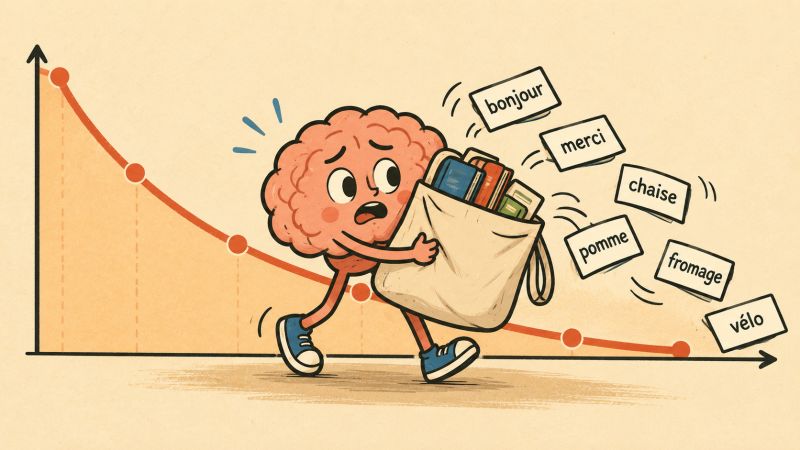
The forgetting curve helps here. Put simply, new information fades quickly if it is not revisited, but each successful retrieval or meaningful encounter can strengthen the memory trace and slow the forgetting down.
And not all encounters are equal.
Seeing a word again is relatively easy. Recognizing it in a sentence is harder, and recalling it from its meaning is harder still.
Spelling it, recognizing it in speech, choosing it in the right context and using it naturally all involve different kinds of processing and retrieval.
That is why ten passive exposures during one lesson are not equivalent to ten varied encounters spread across several weeks.
The number of encounters needed also depends on the word itself:
- Is it similar to a word the learner already knows?
- Is the meaning concrete or abstract?
- Is the spelling predictable?
- Is the pronunciation difficult?
- Does it have several meanings?
- Does it require a particular preposition, gender or collocation?
A useful progression might look like this:
notice → recognize → retrieve → use → retrieve again later
Each return to the word should ideally require a little more from the learner.
So instead of asking “How many times have my students seen this word?”, a better question may be: “How many times have they had to retrieve and use it over time?”
Mechanical repetition is not enough on its own. Durable vocabulary knowledge comes from encounters that are repeated, spaced out and varied, with retrieval getting more demanding as they go.