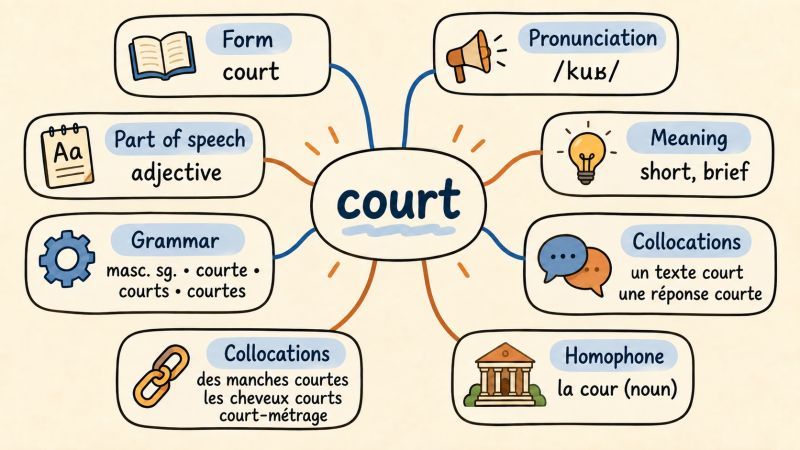
We often talk about vocabulary as if learning a word were a single act: see it, understand the translation, remember it. In practice, lexical knowledge is much more than that.
To memorize a word well, a learner needs to develop several types of knowledge about it:
- form — how it is spelled and pronounced
- meaning — not only a translation, but also nuance and connotation
- semantic boundaries — how it differs from near-synonyms and related words
- register — whether it is neutral, formal, informal or colloquial
- grammar — gender, determiners, prepositions, irregular forms and typical patterns
- collocations — which words naturally occur with it
- lexical connections — related words, expressions and members of the same word family
But lexical knowledge is only part of the picture.
The learner also needs to develop several skills: to recognize the word in speech, to retrieve it without support, to select it appropriately in context, to pronounce and spell it accurately, and to combine it naturally with other words.
And even successful use in one lesson does not mean the word has been learned.
For vocabulary to become genuinely available, it has to be consolidated in long-term memory. That requires repeated encounters over time, ideally in different contexts and through different modes of processing: seeing, hearing, recalling, spelling and using the word in context.
This raises an obvious question for teachers: how can all of this possibly fit into one lesson?
It cannot.
A lesson can introduce a lexical item and begin building some of these connections. But durable vocabulary learning is necessarily cumulative.
Perhaps the more useful way to think about vocabulary teaching is not “Have I taught this word?”
But: “What opportunities has the learner had to build, retrieve and strengthen their knowledge of this word over time?”